
The goal is not to "improve" the title until it sounds better. The goal is to make your resume truthful and understandable at the same time.
A good way to think about it is truth plus translation:
- Truth means keeping the official employment record intact.
- Translation means helping a reader understand the real scope of the role.
Add factual context about your responsibilities rather than relying on the title alone. If the title is too vague, too junior, too senior, or simply unfamiliar, the rest of the resume has to do more of the explanatory work.
Identify what your title leaves unclear
A title may understate your responsibilities, overstate a narrow role, or use internal wording that needs explanation. Decide which applies before changing the entry:
- Understated: show the projects or processes you actually owned in your bullets.
- Overstated: describe your scope without relying on the title to imply wider authority.
- Unclear or hybrid: add a short, accurate description of the function you performed.
How to present the title on your resume without inventing anything
Your resume title line should help the reader understand the job without replacing the official record.
Keep the official title visible
As a practical convention, the official title should usually remain part of the job entry. That protects accuracy and helps avoid confusion if an employer checks your background later.
A simple format is:
Official Title — Company Name
Example:
Operations Associate — Northwind Logistics
If the title is too vague on its own, keep it visible but add context elsewhere.
Add a clarifying descriptor when it helps
If the title is vague or internally specific, you can add a short clarifier in parentheses or after a dash. This is a practical resume convention, not a universal rule. Whether you use it depends on your actual experience, the employer, and the application context.
These illustrative descriptors are appropriate only if they describe work you actually performed:
- Operations Associate (Client Onboarding & Project Coordination)
- Marketing Coordinator — Email and Campaign Operations
- Analyst, Finance Systems (Reporting and Reconciliation)
- Project Coordinator (Vendor and Timeline Management)
A good clarifier does one job: it tells the reader what kind of work the role actually involved.
Avoid replacing the official title entirely
If you were officially a "Customer Support Specialist," do not rewrite the line as "Customer Success Manager" unless that really was your actual role and you can support it.
The difference between clarity and misrepresentation is simple:
- Good: Customer Support Specialist (Account Escalations and Retention Support)
- Not good: Customer Success Manager
The first clarifies. The second changes the record.
Use bullets to demonstrate your responsibilities
Let the title line identify the role and use the bullets to explain the work. Ask what you handled, who you worked with and what changed because of your contribution. Only include results you can support.
Before: Responsible for admin tasks and team support.
After: Coordinated administrative and project support, including scheduling, document preparation and issue tracking.
The second version adds detail without changing the job title. If you handled client onboarding or project timelines, describe that work directly rather than implying a promotion.
Use verbs such as "coordinated," "owned" or "managed" only when they match your actual responsibility. Reserve "directed" or "headed" for work that genuinely involved that authority. Do not borrow an achievement or a number from an example.
For more ways to describe your work, see Resume Bullet Point Examples for Every Industry.
Examples of mismatched-title rewrites for common situations
These are illustrative templates, not formulas you have to copy exactly.
Example 1: The title was junior, but the scope was broad
Official title: Office Assistant
Resume line: Office Assistant (Operations and Client Coordination)
Bullets:
- Coordinated daily scheduling, internal communication, and document flow for a small team
- Managed client follow-up tasks and kept open items visible for the broader group
- Supported process improvements by organizing recurring files, templates, and handoff notes
Why this works: it keeps the real title, but it tells the reader the role was more than basic admin work.
Example 2: The title was vague and internal
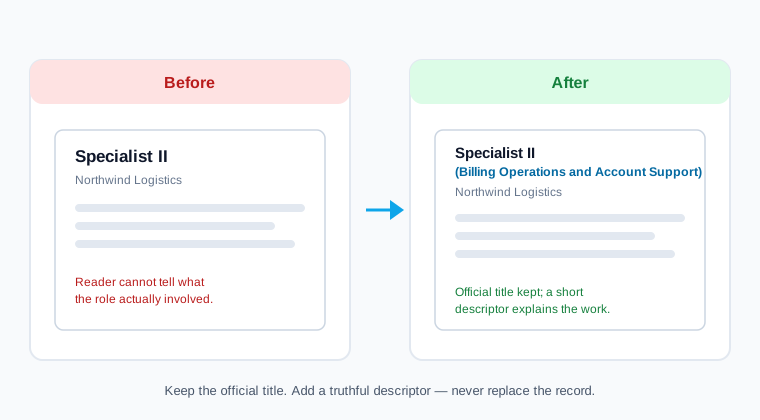
Official title: Specialist II
Resume line: Specialist II (Billing Operations and Account Support)
Bullets:
- Processed billing-related requests and resolved routine account issues with internal teams
- Tracked recurring exceptions and flagged patterns for review
- Maintained clear documentation to support consistent handling across the team
Why this works: the internal title stays intact, but the clarifier makes the role legible to outsiders.
Example 3: The responsibilities were broader than the title suggested
Official title: Coordinator
Resume line: Coordinator (Project Management and Stakeholder Communication)
Bullets:
- Ran project timelines, meeting follow-ups, and status updates across multiple stakeholders
- Kept deliverables moving by identifying blockers and coordinating next steps
- Prepared concise updates for leadership review and team decision-making
Why this works: it shows coordination, but also the level of responsibility inside the role.
Example 4: The title sounded senior, but the role was narrow
Official title: Manager
Resume line: Manager — Customer Service Operations
Bullets:
- Supervised daily team workflow and handled scheduling, queue monitoring, and issue escalation
- Updated process notes and team references to keep work consistent
- Reviewed routine performance metrics and shared observations with leadership
Why this works: the bullet points prevent the title from carrying more weight than the actual scope supports.
Example 5: The job was a hybrid role
Official title: Marketing Associate
Resume line: Marketing Associate (Content, Campaign Support, and Reporting)
Bullets:
- Supported content drafting, campaign coordination, and internal reporting
- Tracked campaign inputs and helped keep deadlines visible across the team
- Collaborated with multiple stakeholders to keep materials accurate and on schedule
Why this works: hybrid roles are easier to understand when the resume names the mix clearly.
What not to do when rewriting a misleading title
When the title is off, it is tempting to "fix" it too aggressively. That usually creates a bigger problem.
Do not claim a title you never officially held
If the company records never showed it and the role was not truly equivalent, do not use it as your primary title.
Do not stack buzzwords into the title line
Avoid title lines like:
- Strategic Growth Operations and Client Success Specialist Manager
- Senior Global Cross-Functional Project Ninja
If the title line reads like a pitch deck, it usually hurts clarity more than it helps.
Do not hide the official title if background checks may matter
A resume should be consistent with payroll, HR records, and application forms. That does not mean every platform must use identical formatting, but the core facts should match.
Do not overcorrect in the other direction
Some job seekers get worried about sounding inflated and make their resume too small. That can look like:
- title only, no context
- duties with no scope
- a short list of tasks that undersells real responsibility
The goal is not to minimize your experience. It is to describe it accurately.
Do not let different versions contradict each other
Your resume, LinkedIn profile, and application form may not need identical presentation, but they should not contradict each other. If one version looks like a different job, that is a red flag.
How to tailor the same experience for different job targets
You do not need a different career history for every application. You do need to emphasize different parts of the same history depending on the job you want.
Start with the target role
Ask which part of your work is most relevant. For example, if you are applying for:
- operations roles, emphasize process coordination, issue tracking, and workflow ownership
- project management roles, emphasize timelines, cross-functional coordination, and follow-through
- customer-facing roles, emphasize communication, escalation handling, and relationship support
- analyst roles, emphasize reporting, documentation, accuracy, and recurring data tasks
Reorder bullets based on relevance
If one job is more project-heavy and another is more client-facing, you do not need to rewrite the entire job. Bring the most relevant bullets to the top.
Adjust the descriptor, not the facts
A role can be described in more than one legitimate way, as long as the facts stay the same:
- For an operations application: Coordinator (Workflow and Process Support)
- For a client-focused application: Coordinator (Client Communication and Escalations)
Both versions are honest if both reflect the actual work.
Match the application form carefully
Some application forms ask for a title exactly as it appeared in HR records. In that case, use the official title. If there is a separate field for describing responsibilities, use that space to add clarity.
Keep LinkedIn and resume aligned
LinkedIn does not need to duplicate your resume, but it should tell the same story. If your resume uses a clarifying descriptor, your profile should not imply a different job altogether.
Use tools to test clarity, not to rewrite the truth
If you use an AI resume builder or editor, treat it as a drafting tool. Resumeva offers editable resume tools, AI writing assistance, resume import, job-description matching, ATS-oriented resume checks, examples, cover-letter drafting and PDF export to help you improve wording while keeping your career facts accurate.
Use the tools to make the story clearer, not to change the story.
A quick checklist before you submit the resume
- Does the job title stay truthful to what HR would recognize?
- If you added a descriptor, does it reflect real work rather than aspiration?
- Is the role understandable without knowledge of your company's internal titles?
- Do the bullets show scope, not just tasks?
- Have you avoided inflated words in the title line?
- Does the summary reinforce the same story as the experience section?
- If the role is being tailored, are you emphasizing different evidence without changing the facts?
- Would your application still make sense if someone compared it to your LinkedIn profile or employment records?
Keep the employment record honest and use the resume to explain the responsibilities you actually held. A clarifying descriptor is context, not a claim to a different title or a promise of an application advantage.
FAQ
What if an application form asks for the exact official title?
Use the title from your employment records in that field. Add context in the responsibilities field if the form provides one.
What if I was given additional responsibilities but no formal promotion?
Keep the official title and describe the additional work in your bullets. Do not imply a formal promotion or change the dates unless your records support it.