What Is an AI Interview? The New Interview Process Explained
AI interviews replace part of the recruiter screen with software that scores your answers. Here's what to expect, how the scoring actually works, and how to prepare.
 resumeva.com
An AI interview is a job interview where artificial intelligence software, not a person, asks the questions and grades your answers before a human recruiter ever sees you. Around 43% of large companies now use AI in some part of the interview funnel, so it pays to understand what the format rewards and where it trips people up. This guide walks through what happens under the hood, what the software actually looks for, and the habits that consistently move candidates through to the human round.
What is an AI interview?
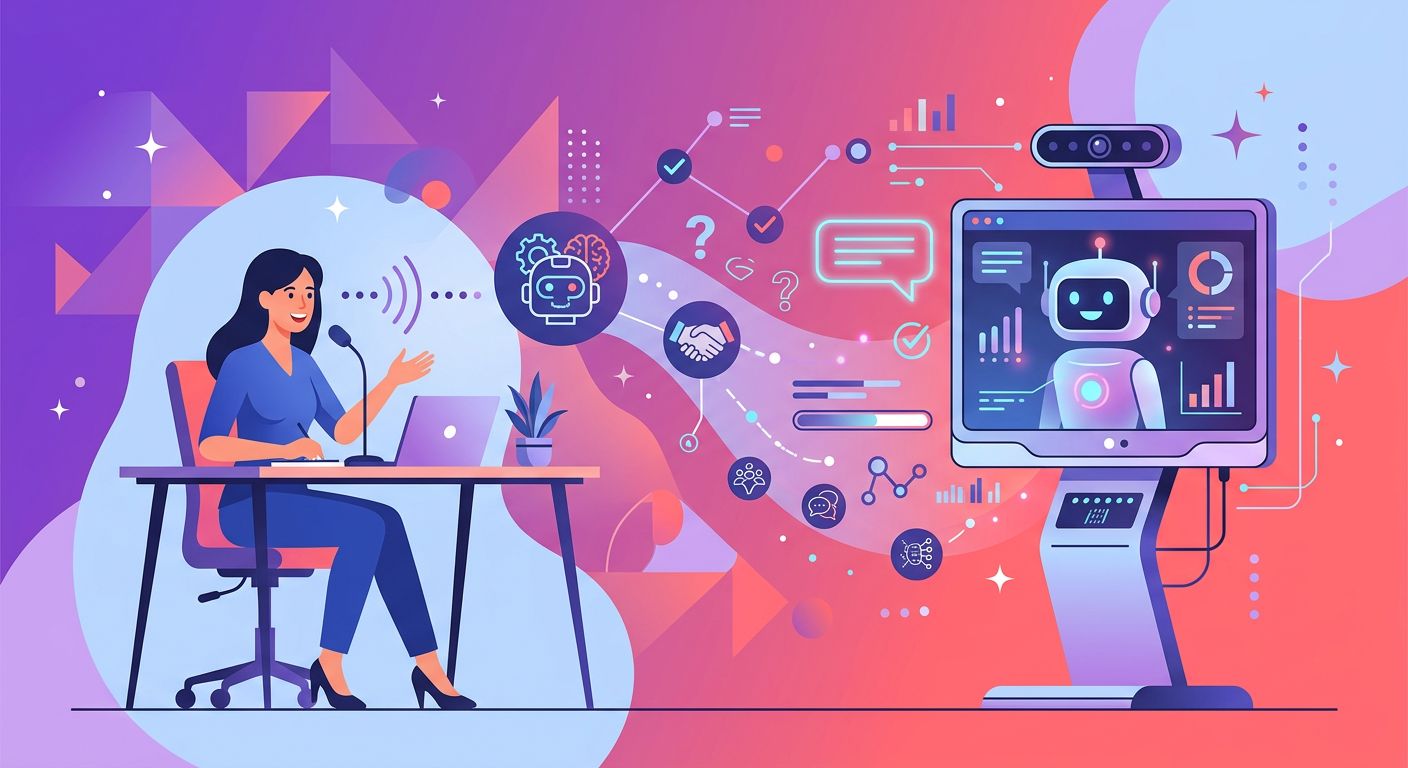
You record video or text responses to a set of pre-loaded questions. The system transcribes what you say, analyzes your words, tone, and delivery against the role, and passes a score to a human recruiter. The recruiter makes the actual advance/reject call — the AI just decides whose recording gets watched.
How AI interviews work — the four stages
Most platforms follow the same flow whether they're video or text based.
- Question delivery — a prompt appears as text or a short recorded clip from the hiring team
- Your response — you answer on camera or by typing, usually within a 2–3 minute limit
- AI analysis — the software transcribes and uses natural language processing to weigh keywords, relevance, and communication style
- Scoring — candidates are ranked and the strongest recordings are surfaced to a human reviewer
The main types of AI interviews
Not every AI interview looks the same — the format changes what the software rewards.
- One-way video (HireVue, Modern Hire) — you record answers to pre-set questions on your own time
- Chat-based (Sapia, Paradox) — you type answers into a chatbot on your phone or laptop
- Live AI interview — a real-time voice agent conducts the interview like a phone screen
- Game-based assessments — short cognitive games that measure working memory, pattern recognition, and processing speed
Why companies use AI interviews
High-volume roles routinely draw hundreds of applicants for a single opening. Automating the first screen gives every candidate the same questions under the same conditions, protects the recruiter's time, and creates a structured signal earlier in the funnel. For the employer, it's less about replacing recruiters and more about surfacing the top of the pile faster.
What the AI actually scores
Modern platforms have largely moved away from facial expression analysis (which is now legally restricted in Illinois, New York City, and several EU jurisdictions) and toward transcript-based scoring. That means the software mainly grades what you say — relevance to the question, coverage of expected themes, structure, and clarity. Audio quality matters because it affects transcription accuracy.
Is an AI interview good or bad for candidates?
Both. You can take it on your schedule, everyone answers the same questions, and some platforms let you re-record once. On the other side, there's no interviewer to build rapport with, humour and nuance get missed, and speech differences can be misread. Treat it as a gate to the human round — clear, structured, keyword-relevant answers beat clever ones.
Remote setup checklist
- Wired ethernet or a strong wifi signal — audio dropouts break transcription
- Wired headset if you have one; avoid Bluetooth AirPods for longer sessions
- Camera at eye level, main light in front of you, plain background
- Close every other app to protect bandwidth and prevent notifications
- Do the platform's built-in tech check twice, in the exact spot you'll record from
Answer structure that scores well
Start each answer with a one-line direct response to the question. Give a specific example. End with a one-line summary of the outcome. Under 90 seconds is fine — the scoring model rewards clarity, not length. Padding to 'use the full time' is the most common self-inflicted score hit.
Common mistakes
- Reading a script — the delivery reads as robotic and the transcript flags repetition
- Trailing off ('yeah, so… that's kind of it') and giving up the last five seconds
- Answering a different question than the one asked — the transcript flags low relevance
- Staring at your own preview instead of the lens
- Skipping the tech check and finding out too late that your mic was muted
Your rights as a candidate
Several jurisdictions now require companies to disclose the use of AI in hiring, offer accommodations for candidates with disabilities, and — in some cases — provide a non-AI alternative on request. Ask the recruiter for the platform name, whether human review happens, and what accommodations are available. Employers expect these questions.
Why this matters
The advice in this guide is drawn from real recruiter conversations and analysis of what actually moves candidates forward. Apply it as a checklist on your next application.
Put it into practice
Don't try to apply everything at once. Pick the one or two changes that feel most relevant to your situation, ship the update, and measure the response over your next 10 applications.
Common mistakes to avoid
- Treating advice as universal — context always matters
- Over-editing until your voice disappears
- Skipping the proofread because you've read it 30 times
- Forgetting that recruiters are people, not algorithms
Build your ATS-friendly resume
Choose a layout and build a resume using your own experience.
Check your ATS score
Review what Resumeva extracts and the findings its own scoring method produces.
Frequently asked questions
What is an AI interview?+
A job interview where software, not a person, asks the questions and grades your answers before a human recruiter watches. You record video or text responses, the system transcribes and scores them, and the top-ranked recordings are surfaced to a recruiter.
Do AI interviews watch my face?+
Most major platforms have moved away from facial expression analysis (which is now legally restricted in Illinois, NYC, and several EU jurisdictions) toward transcript-based scoring. The software mostly grades what you say — not how you look while saying it.
Can I re-record my answer?+
It depends on the platform and the employer's configuration. Some allow one re-record per question. Use it if you froze or had an audio issue — not just to chase perfection.
How do I know if a company uses AI interviews?+
The invite email will name the platform (HireVue, Modern Hire, Sapia, Paradox). Several jurisdictions now require companies to disclose AI use in hiring — ask the recruiter if it's unclear.
Are AI interviews fair?+
Better than an unstructured first round in some ways (every candidate gets the same questions), worse in others (no rapport, nuance can be missed). Treat it as a gate to the human round and answer with clear, keyword-relevant structure.
Can I request a human interview instead?+
In some jurisdictions, yes — employers must offer accommodations for candidates with disabilities and, in some cases, a non-AI alternative on request. Ask the recruiter what options are available.
Keep building
Tools and examples that pair with this guide.
General career guidance and examples. Adapt suggestions to your own experience; employer requirements and hiring outcomes vary.